You’ve chosen Barcelona — now you need to know what it will cost. This guide gives concrete, Barcelona-specific numbers: a realistic daily spend, total estimates for common trip lengths, and a category-by-category breakdown so nothing surprises you. Every figure here is a range, not an invented exact price, because real costs shift with season, booking timing, and travel style. We cover what a budget, mid-range, or luxury day looks like, what three, five, and seven days add up to, where your money actually goes, whether Barcelona counts as expensive, and the highest-impact ways to spend less without gutting the trip. Use it to size your budget before you commit, then book with confidence.
Quick Answer
A Barcelona trip costs roughly €120–200 per person per day for a typical mid-range traveler, excluding flights. Travel style and trip length move the total most, splitting spend across budget, mid-range, and luxury tiers. Mid-range visitors should budget around €150 per day plus the per-night tourist tax, and book major attractions ahead.
Trust Layer
Tripstou planning guide for travelers resolving one travel decision. Covers the main variable, traveler context, and practical tradeoffs.
Produced with AI assistance and reviewed by Alex Perrut, working in tourism since 2015, for the Tripstou editorial team. See our editorial process for details.
Last factual review: September 21, 2026.
Official sources consulted: European Union official portal, European travel information portal, Agència Tributària de Catalunya, Transports Metropolitans de Barcelona.
Key Takeaways
- A mid-range Barcelona trip costs roughly €120–200 per person per day before flights, set mainly by travel style.
- Three travel-style tiers set the pace: budget €60–90 a day, mid-range €120–200, and luxury €300 or more.
- Total cost scales with nights: roughly €450–800 for three days and €1,000–1,800 for a week, per person.
- Accommodation and food drive most of the budget, so where you sleep and eat decides your total.
- Barcelona charges a tourist tax of roughly €6–12 per person per night on top of room rates.
- Eating the menú del día at lunch and booking attractions early are the biggest evergreen savings levers.
Table of Contents
How much does a Barcelona trip cost?
A Barcelona trip costs roughly €120–200 per person per day for most mid-range travelers, before flights. Total spend follows a simple formula: daily cost multiplied by trip length, plus the per-night tourist tax. Your travel style sets the daily figure, and your number of nights scales it.
That daily range covers accommodation, food, local transport, and a couple of paid attractions. It excludes international flights, which vary too widely by origin and season to fold into a per-day figure. Budget travelers can land well below the range, and luxury travelers far above it, so treat these as planning ranges and verify current rates before booking.
The rest of this guide breaks the formula apart: the per-day tiers that set your daily figure, the totals for common trip lengths, and the category split that shows where the money actually flows. If you only remember one thing, remember that nights and travel style — not headline attraction prices — decide your total.
Barcelona daily budget by travel style
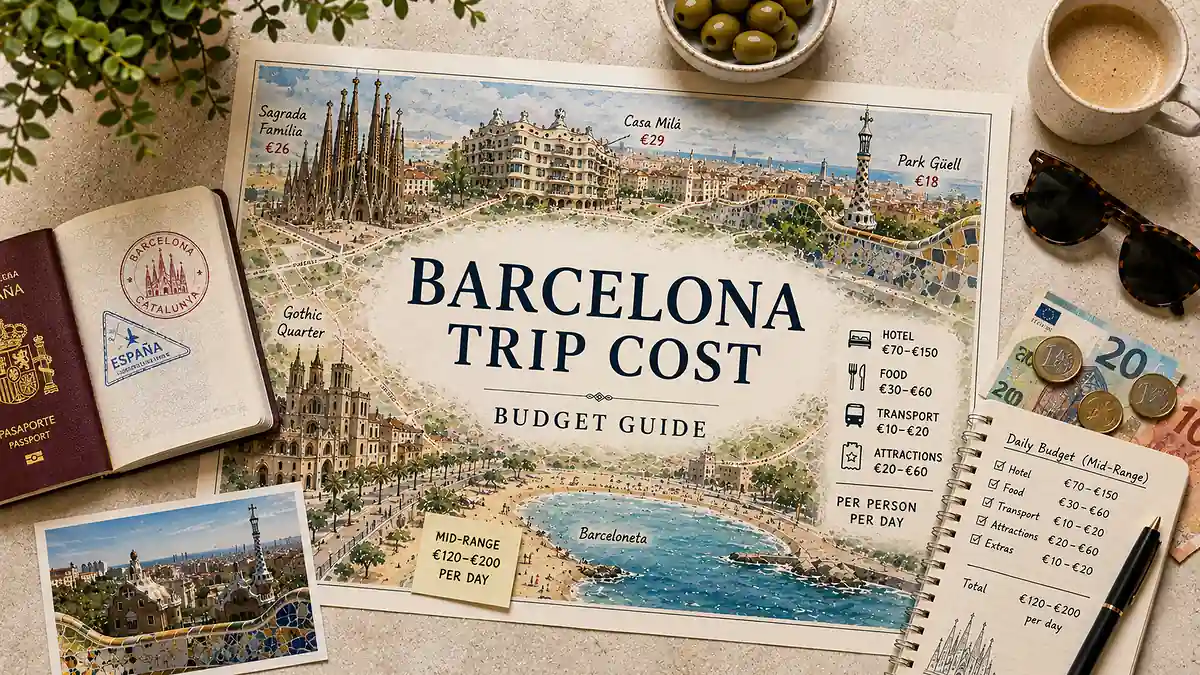
Barcelona’s daily budget splits into three tiers: budget, mid-range, and luxury. Budget travelers spend roughly €60–90 per day, mid-range around €120–200, and luxury €300 or more. Where you land depends mostly on accommodation and how often you eat out. The table below places each style against a realistic per-day range.
| Travel style | Typical accommodation | Eating pattern | Per-day range |
|---|---|---|---|
| Budget | Hostel dorm or shared room | Markets, menú del día, picnics | €60–90 per day |
| Mid-range | Three-star hotel, double room | Cafés plus one sit-down dinner | €120–200 per day |
| Luxury | Four- or five-star hotel | Fine dining and private tours | €300+ per day |
The jump between tiers comes almost entirely from where you sleep and how you eat. A dorm bed and lunchtime menús keep budget travelers near €60–90, while a comfortable hotel and table-service dinners push mid-range spending toward the upper end. Luxury travelers cross €300 mainly through premium rooms, fine dining, and private experiences rather than higher entry fees.
Reality check: accommodation is the single biggest lever between tiers — moving from a private room to a dorm, or from peak to shoulder season, saves more per night than trimming any other category. Treat each tier as a range and verify live prices, since season and demand shift the bands.
What does a 3, 5, or 7-day Barcelona trip cost?
A mid-range Barcelona trip costs roughly €450–800 for three days and €1,000–1,800 for seven days, per person before flights. Five days falls in between, around €700–1,300. Costs scale almost linearly with nights, because daily spend repeats, while fixed one-off costs like the airport transfer spread thinner over a longer stay.
Here is how typical mid-range totals shape up by length, all per person and excluding flights:
- 3 days: roughly €450–800 — a fast city break covering the headline sights.
- 5 days: roughly €700–1,300 — room for slower days and a half-day trip.
- 7 days: roughly €1,000–1,800 — a full week with attractions and dining built in.
Rule: short trips cost more per day than long ones, because fixed costs like the airport transfer and a minimum-stay mindset don’t shrink with fewer nights. Stretching a trip by a day or two rarely raises the daily rate. To see how these totals map onto an actual plan, pair this with our 2-day Barcelona itinerary or the fuller 3-day Barcelona itinerary. Treat every total as a range and confirm current prices before booking.
Where your money goes: cost breakdown by category
Accommodation and food dominate a Barcelona budget, together claiming over half of most travelers’ spend. Transport, attractions, and the per-night tourist tax fill out the rest. The table below breaks each category into a typical range so you can see where your money actually goes.
| Category | Typical range | Main cost driver |
|---|---|---|
| Accommodation | €25–250+ per night | Star rating and booking season |
| Food and dining | €25–60 per day | Menús versus sit-down dinners |
| Local transport | €12–25 per stay | T-casual versus single tickets |
| Attractions | €18–45 per site | Headline Gaudí landmarks |
| Tourist tax | €6–12 per night | Accommodation category and stay |
Accommodation: what a night costs
A night in Barcelona runs roughly €25–45 for a hostel dorm, €100–180 for a mid-range double, and €250 or more for luxury. Season drives the biggest swings, with summer and major events pushing rates to the top of each band. Booking early protects the lower end of every range.
These bands cover the room only; where you stay shapes both price and convenience. For choosing the right base and area trade-offs behind the price, see our guide to where to stay in Barcelona. Always verify live nightly rates, since they move fast with demand.
Food and dining: daily eating budget
Expect to spend roughly €25–60 per day on food in Barcelona, depending on how you eat. A weekday menú del día lunch typically runs about €13–18 for multiple courses, while a mid-range sit-down dinner lands around €25–45 per person. Markets, bakeries, and casual tapas keep the daily figure toward the bottom.
The fastest way to control this category is meal timing: lunch menús deliver far more food per euro than evening dining. Drinks and wine add up quickly, so a few sit-down dinners can move you from the lower to the upper range. Treat these figures as ranges and adjust for your own appetite and pace.
Getting around: transport costs
Local transport is one of Barcelona’s cheapest categories, often €12–25 for an entire trip. A T-casual card covering ten metro and bus rides costs roughly €12–13, while single tickets run a few euros each. Most visitors cover the compact center on foot and ride only occasionally.
For the airport, budget anywhere from about €5–6 by metro or train to €30–40 for a taxi, depending on the option you choose. The mechanics of cards, zones, and routes sit in our Barcelona transport guide, and the full airport options are covered in Barcelona airport transport. These costs are sensitive to fare changes, so verify current prices before you travel.
Attractions and tickets
Barcelona’s headline attractions cost roughly €18–45 each. Sagrada Família typically runs about €26–40 depending on ticket type, Park Güell around €18, and Casa Batlló roughly €29–45. A day mixing two or three paid sights is what pushes the attractions line up for most travelers.
Costs climb when you add guided access, tower entry, or audio extras, so the upper end of each range reflects premium tickets. Many viewpoints, parks, and neighborhoods cost nothing, which keeps a sightseeing-heavy trip affordable if you balance paid and free. Confirm current entry prices when you book, as they change periodically.
Tourist tax: what to budget per night
Barcelona charges a tourist tax per person per night, combining a regional levy with a municipal surcharge. It typically ranges from about €6 to €12 per night, scaling with your accommodation category and length of stay. The combined rate recently increased, so confirm the current amount when booking.
The tax is usually collected separately at check-in or check-out rather than included in the room rate, so factor it in as an extra line on top of your nightly price. Over a week it can add a meaningful sum, especially in higher-category hotels. Treat the per-night figure as a range and verify before you pay.
Hotels and places to stay
Compare hotels, apartments and stays for your dates in one search.
Search hotels and stays on hotels.com →
Tripstou may earn a commission if you book through this link, at no extra cost to you.
Is Barcelona expensive or good value?
Barcelona is moderately priced for a major European city, and most travelers consider it good value. The single biggest variable is accommodation, which swings hardest by season and how central you stay. Whether it feels expensive depends on your travel style far more than on the city itself.
The value case is strong because so much of Barcelona is enjoyable for free: the beach, the parks, Gaudí facades from the street, and walkable neighborhoods. Paid attractions and dining are where costs concentrate, and both are easy to dial up or down. A traveler who sleeps modestly and walks the city can keep daily spend low without missing the experience.
Reality check: Barcelona rewards spending on experiences over hotels — a central, simple room plus well-chosen paid sights usually beats an expensive room in a quieter spot. For how Barcelona fits into the wider national picture, see our Spain travel budget guide.
How to cut costs on a Barcelona trip
The biggest saving lever in Barcelona is eating your main meal at lunch. The menú del día delivers a multi-course meal for a fraction of dinner prices. Booking attractions online ahead, using a T-casual transport card, and traveling in shoulder season stack further savings without cutting the experience.
The highest-impact, evergreen levers that lower the total without ruining the trip:
- Eat the menú del día: a multi-course lunch costs far less than the equivalent dinner.
- Book attractions in advance online: avoid premium last-minute and guided-only tickets.
- Use a T-casual card: ten shared rides cost less per trip than single tickets.
- Travel in shoulder season: spring and autumn cut accommodation off peak rates.
- Mix free sights with paid ones: beaches, parks, and neighborhoods cost nothing.
The trade-off is planning: the savings come from booking early and committing to a schedule, which suits organized travelers more than spontaneous ones. Rule: reserve Sagrada Família and Park Güell weeks ahead — same-day slots sell out and push you into pricier guided options or a wasted trip. For broader money and practical advice, see our Barcelona travel tips.
Tours and activities
Book skip-the-line tickets, day trips and local tours with free cancellation on most activities.
You can also browse everything on getyourguide.com.
Tripstou may earn a commission if you book through this link, at no extra cost to you.
Frequently Asked Questions
What is the Barcelona tourist tax?
Barcelona charges a tourist tax per person per night, combining a regional levy with a city surcharge. It typically runs from about €6 to €12, scaling with your accommodation category. Hotels usually collect it separately at check-in or check-out, so budget it on top of your nightly room rate.
How much is the metro and transport in Barcelona?
Budget about €12–25 on local transport for a whole Barcelona trip. A T-casual card gives ten shared metro and bus rides for roughly €12–13, far cheaper per ride than single tickets at a couple of euros each. Since the center is walkable, most visitors only need one card.
What is the average daily spend for a mid-range traveler in Barcelona?
A mid-range traveler spends around €120–200 per person per day in Barcelona, excluding flights. A practical planning figure is roughly €150 a day, covering a comfortable hotel room, casual meals with one sit-down dinner, occasional transport, and a paid attraction. Add the per-night tourist tax on top of that figure.
Is Barcelona cheaper in the off-season?
Yes, Barcelona is noticeably cheaper outside peak summer, mainly through accommodation. Spring and autumn shoulder seasons bring lower nightly rates and smaller crowds, while winter can drop prices further. Flights and attractions stay fairly stable, so the off-season saving comes almost entirely from where you sleep rather than what you do.
How much cash should I carry in Barcelona?
Carry only modest cash in Barcelona, as cards are accepted almost everywhere, including small cafés and transport machines. Around €50–100 in cash comfortably covers markets, tips, and the occasional cash-only spot. Keep the rest on a card, and use ATMs attached to banks to avoid high independent-machine fees.
How far in advance should I book Barcelona attractions?
Book Barcelona’s headline attractions several weeks ahead, especially Sagrada Família and Park Güell, where timed slots sell out fast. Early booking secures standard online prices and avoids being pushed into pricier guided or last-minute tickets. For a short trip, reserve your must-see sights as soon as your dates are confirmed.
Related Guides
- Barcelona travel guide — the full city hub and starting point for planning.
- Where to stay in Barcelona — choose the right base behind the price bands.
- Barcelona transport guide — cards, zones, and getting around the city.
- 3-day Barcelona itinerary — see how costs map onto a real plan.
- Barcelona travel tips — practical money and on-the-ground advice.
- Spain travel budget guide — the national budgeting picture.
Did this guide save you time or money? Tripstou is independent and reader-funded — if you'd like to give something back, you can support the site with a crypto contribution of any size.