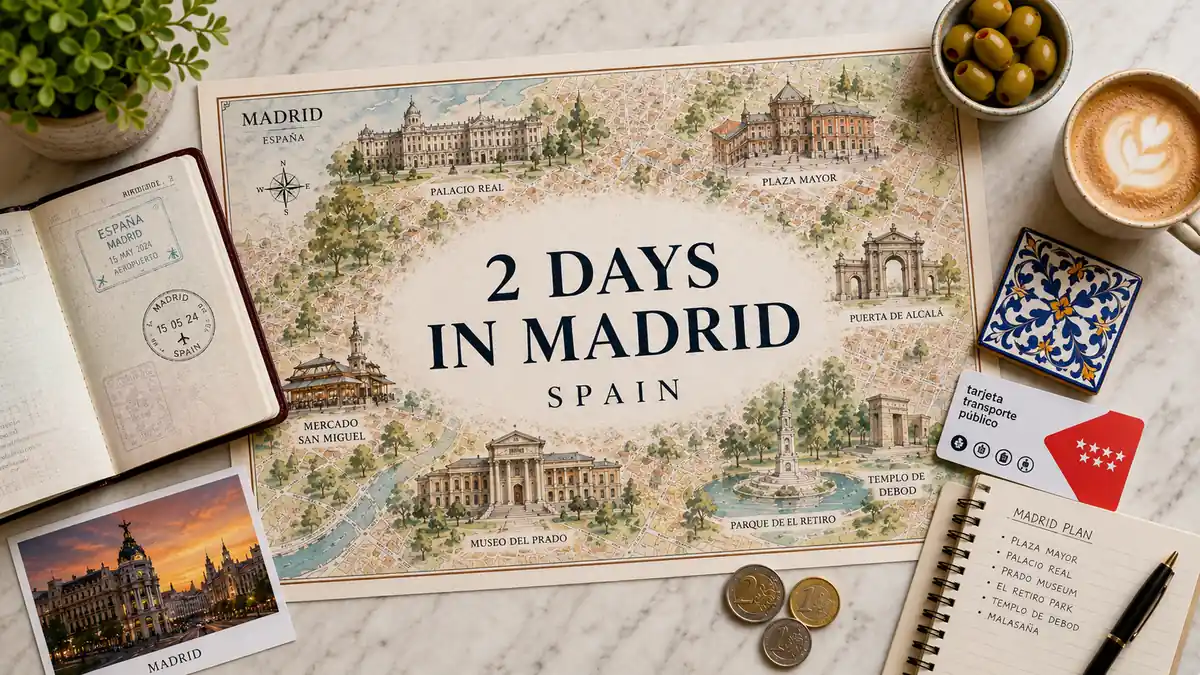
Two days in Madrid is enough to see the historic core and the marquee museums, as long as you sequence the route well. The mistake first-timers make is zig-zagging across the centre and losing an hour to backtracking that could have gone to the Prado or a lap of Retiro. This itinerary fixes that with a simple west-to-east flow. Day 1 anchors on the art-and-park side of the centre; Day 2 covers Habsburg Madrid, the Royal Palace, and the tapas streets of La Latina. Museums sit in the mornings, neighbourhoods and tapas fill the evenings, and every stop connects on foot. You will not need a car, and you will barely touch the metro. What follows is a ready-to-follow, day-by-day plan built for a first visit: order first, pacing second, no rushing.
Quick Answer
Spend Day 1 on the Prado, Retiro, and literary quarter, and Day 2 on the Royal Palace and La Latina. Keep museums in the morning and neighbourhoods and tapas in the evening, walking everywhere with minimal backtracking. Two days suits first-timers who want the core; add a third day only for a day trip.
Trust Layer
Tripstou itinerary guide for travelers planning a route. Covers pacing, stop count, stop order, base logic, and trip length.
Produced with AI assistance and reviewed by Alex Perrut, working in tourism since 2015, for the Tripstou editorial team. See our editorial process for details.
Last factual review: July 21, 2026.
Official sources consulted: spain.info, tourspain.es.
Key Takeaways
- Split the trip west-to-east: Day 1 covers the Prado, Retiro, and the literary quarter; Day 2 takes the Royal Palace and La Latina.
- Keep museums in the morning and neighbourhoods with tapas in the evening, so your sharpest hours go to the demanding indoor sights.
- Book the Prado and Royal Palace ahead and arrive near opening, before tour groups thicken the marquee interiors.
- A central base around Sol keeps the whole route on foot, leaving the metro for the airport run alone.
- Time Templo de Debod for sunset and arrive early, since the western railing fills well before the light drops.
- Two days covers Madrid’s core comfortably; spend any third day on a day trip rather than another museum.
Table of Contents
The 2-Day Madrid Itinerary at a Glance
The two-day route splits cleanly: art and park on Day 1, palace and tapas on Day 2. Both days run west-to-east through the centre, so you walk forward all day instead of doubling back. Museums open the mornings; neighbourhoods and food close the evenings.
Here is the whole route in one scan. Each leg lines up with the day blocks below, in the same order you will actually walk them:
- Day 1 morning: Prado — the art core
- Day 1 midday: Retiro — a quick park loop
- Day 1 evening: literary quarter to Sol and Plaza Mayor — old-Madrid streets
- Day 2 morning: Royal Palace and Almudena — Habsburg Madrid
- Day 2 late afternoon: Templo de Debod — the sunset viewpoint
- Day 2 evening: La Latina — tapas night
The order is built to save the walking, not fill it. Both marquee anchors, the Prado and the Royal Palace, get a fresh morning slot before the crowds thicken and before you tire. Everything after them flows downhill, geographically and in energy: parks, streets, a viewpoint, then food.
The Prado and Templo de Debod sit at opposite ends of the day for a reason. One needs an unhurried, crowd-free morning; the other only works when the sun is dropping. Stack them on the same half-day and you waste one of them. If you are still weighing two days against a longer trip, the Madrid city guide compares itinerary lengths and helps you settle the duration before you commit to this route.
Day 1: The Prado, Retiro & the Literary Quarter
Day 1 spans the art-and-park side of the centre, from the Prado east to Retiro, then west to Sol. Start at the Prado when it opens, step into Retiro next door for a short loop, then head back west through the literary quarter toward Puerta del Sol and Plaza Mayor for the evening.
The logic is that the day peaks early and unwinds from there. You spend your sharpest hours inside a world-class collection, walk the museum off in green space, then let the afternoon soften into browsing streets and settling in for dinner. Nothing on Day 1 asks you to cross the city twice.
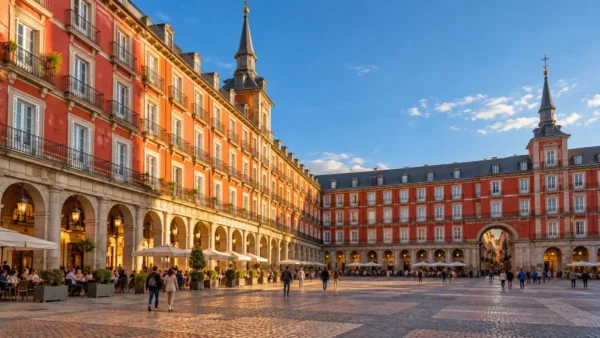
The onward move is easy. From Retiro’s western gates it is a flat fifteen-minute walk down through the Barrio de las Letras — the old literary quarter, where lines from Cervantes and Lope de Vega are set into the pavement — to Puerta del Sol. Plaza Mayor is two minutes further, which sets you up for a first night of tapas on Day 2’s starting side.
Museo del Prado on a 2-Day Trip
The Prado anchors the morning because it is the most demanding stop of the trip and deserves your freshest hours. It ranks among the great painting museums in the world, and a first visit is about choosing a handful of rooms well, not marching past everything.
Book online ahead to skip the ticket queue, and go early to beat the tour groups. There is a free-entry window in the final hours of the day, but it draws heavy crowds and eats into your Retiro time, so it rarely suits this route. Treat any prices and opening times as ranges and confirm them on the official museum site before you go.
The Prado rewards a first, unhurried hour more than any later stop on this trip. Pick three or four must-see rooms before museum fatigue sets in. Nobody absorbs the whole collection in one visit, and the second hour on tired feet is where a great museum turns into a blur.
Retiro Park: What to See in an Hour
Retiro needs about an hour, and that hour is a walkable highlights loop, not a full circuit. The park sits directly behind the Prado, which is exactly why it lands here: it is the natural decompression stop after a big museum.
Aim for two things and let the rest happen on the way. Walk to the boating lake with its grand colonnade, then cut across to the Crystal Palace, a glass-and-iron pavilion tucked among the trees. Both are close, both cost nothing to look at, and together they give you the park’s best moments without swallowing the afternoon.
Tours and activities
Book skip-the-line tickets, day trips and local tours with free cancellation on most activities.
You can also browse everything on getyourguide.com.
Tripstou may earn a commission if you book through this link, at no extra cost to you.
Day 2: Royal Palace, Templo de Debod & La Latina
Day 2 runs through Habsburg Madrid: the Royal Palace and Almudena in the morning, Debod at sunset, tapas after. Cover the palace complex first, wander the Habsburg streets around Plaza Mayor, then drift west to Templo de Debod for golden hour before dinner in La Latina.
This day mirrors Day 1’s rhythm on the western half of the centre. The heavy indoor sight comes first, the streets and viewpoints come next, and the evening lands in a neighbourhood built for eating. Because you ended Day 1 near Plaza Mayor, you begin Day 2 only a short walk from the palace, so there is no wasted crossing to start.
The onward move at the end of the palace visit takes you west on foot: past the Almudena Cathedral, through the Habsburg lanes, and out toward the Templo de Debod gardens in time for sunset. From there, La Latina is a short walk back east, closing the loop where the tapas streets begin.
Visiting the Royal Palace of Madrid
The Royal Palace anchors Day 2’s morning because it is the day’s one big-ticket interior and pairs naturally with the Almudena Cathedral next door. It is the largest royal palace in Western Europe by floor area, and the state rooms are the reason to arrive early, before tour groups fill the route.
Buy tickets ahead and arrive near opening to keep the visit under two hours. Opening times shift with state events, which can close parts of the palace at short notice, so check the official schedule the day before. Step into the Almudena while you are there — it is right across the plaza and takes only a few minutes.
Templo de Debod at Sunset
Templo de Debod is Day 2’s golden-hour stop, a genuine ancient Egyptian temple set in a hilltop park with an open western view. It is the natural bridge between the afternoon and dinner: quiet, free to walk up to, and pointed straight at the setting sun.
The catch is timing and crowds. The lawn and the western railing fill up well before sunset, so arriving thirty to forty minutes early is the difference between a clear view over the reflecting pools and the back of someone’s phone. Once the light goes, La Latina is a fifteen-minute walk east for dinner.
Where to Eat Tapas in La Latina
La Latina is Madrid’s classic tapas neighbourhood and the right place to end Day 2. Its narrow streets pack in more tabernas per block than anywhere else in the centre, which makes it built for grazing across several bars over committing to one restaurant.
Cava Baja is the street everyone names, a dense run of tapas bars you can crawl end to end. The move is to order a drink and one or two small plates at each stop, then move on. Prices swing by bar and by whether you stand or sit, so treat any figure as a rough guide. Standing at the bar is almost always cheaper and livelier than taking a table.
Where to Stay and Get Around for 2 Days
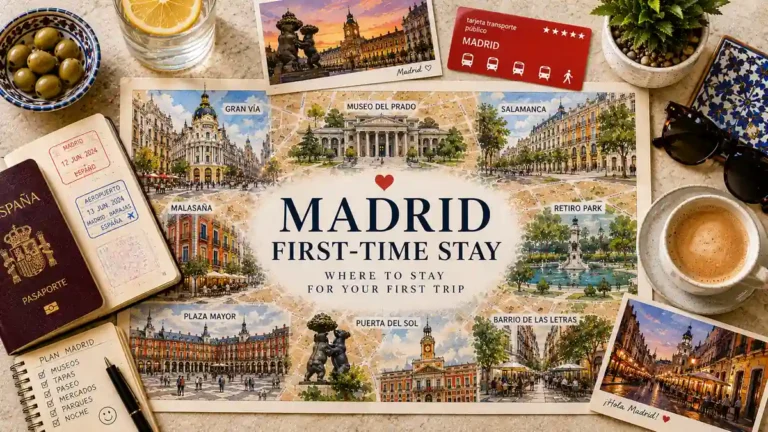
A central base around Sol or Centro makes the entire two-day route walkable. From there you reach every stop on foot, and the metro covers the airport run and anything further out. Where exactly to book, how the metro works, and what a trip costs live in the dedicated guides below.
For a two-day visit the base choice comes down to one thing: stay inside the centre and the route becomes one long walk with no transfers. Sol and the surrounding Centro streets put you between Day 1’s eastern half and Day 2’s western half, so neither day starts with a commute.
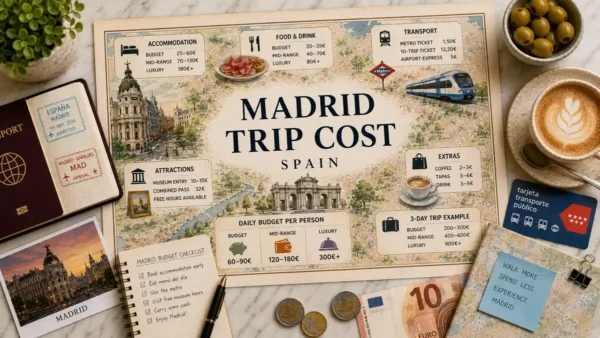
For the deeper decisions, follow the specialists. Compare neighbourhoods and hotels in the Madrid where-to-stay guide, learn the metro and passes in the getting-around guide, plan the arrival with the airport transport guide, and size the budget with the Madrid trip cost guide. This page keeps logistics deliberately shallow so the route stays the focus.
Hotels and places to stay
Compare hotels, apartments and stays for your dates in one search.
Search hotels and stays on hotels.com →
Tripstou may earn a commission if you book through this link, at no extra cost to you.
How to Adapt This Route with More or Fewer Days
With less time, cut Retiro first — it is the most compressible stop on the route. Two days already covers Madrid’s core comfortably. A third day is better spent on a day trip to Toledo or Segovia than on more of the city, and that plan lives on the three-day route.
Timing moves this itinerary more than anything else you can change. Here is what gives way when the clock shrinks, and what to add when it grows:
- Only one full day: drop Retiro and Templo de Debod first, keep both marquee anchors, and merge the best of both evenings into one La Latina tapas night.
- Half a day short: trim the Retiro loop to the lake alone and skip the literary-quarter detour, walking straight from the Prado to Sol.
- A third day free: do not add a fourth museum. Take a day trip out of the city instead.
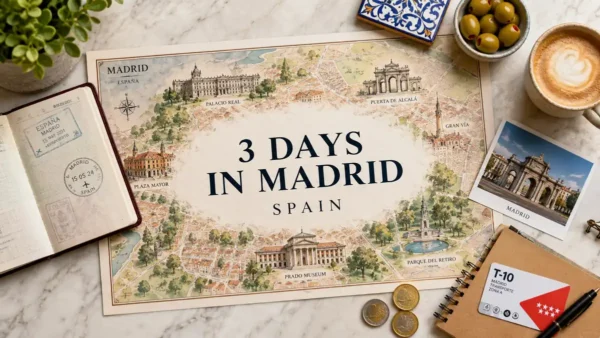
Another indoor sight does not improve a Madrid trip the way a change of scenery does. The centre is dense enough that a third day inside the city hits diminishing returns, which is exactly why the extra day belongs outside it. For the full third-day and day-trip plan, follow the 3-day Madrid itinerary, which handles Toledo and Segovia in the depth they need. This page stops at two days on purpose.
Frequently Asked Questions
Is 2 days enough to see Madrid?
Yes, two days is enough to see Madrid’s historic core and its marquee museums. It covers the Prado, the Royal Palace, Retiro, Templo de Debod, and a tapas night in La Latina at a comfortable pace. Add a third day only if you want a day trip to Toledo or Segovia.
When is the best time to visit Madrid?
Spring and autumn are the best times to visit Madrid, roughly April, May, September, and October. These months bring mild, walkable weather that suits a museum-and-neighbourhood itinerary. Summer can be intensely hot, which makes midday sightseeing tiring, while winter is quieter and cooler but still comfortable for indoor sights and tapas.
Do you need to book Prado tickets in advance?
Yes, booking Prado tickets online in advance is strongly recommended, especially on weekends and in summer when slots sell out. Advance booking also lets you skip the ticket queue and start your visit near opening, when the galleries are quietest. A free-entry window runs in the final hours, but it draws heavy crowds.
What time do restaurants open in Madrid?
Madrid eats late, so restaurants generally serve lunch from around 2pm and dinner from about 9pm. Many kitchens close between lunch and dinner during the afternoon siesta, so arriving at 7pm often means empty dining rooms. For your tapas night in La Latina, plan to sit down closer to 9pm than 7.
Is the 2-day Madrid route very walkable?
Yes, the 2-day route is almost entirely walkable from a central base near Sol. Both days flow west-to-east through the compact centre, so most stops sit ten to fifteen minutes apart on foot. You will only really need the metro for the airport run or anything further out beyond the historic core.
Should you visit the Prado on Day 1 or Day 2?
Visit the Prado on Day 1, first thing in the morning. It asks more concentration than anything else on the route, so it rewards fresh legs and an uncrowded gallery before fatigue sets in. Day 1 placement also lets Retiro, right behind it, work as a natural decompression walk straight afterwards.
Related Guides
- Madrid City Guide — the hub that compares itinerary lengths and plans the whole trip.
- 3 Days in Madrid — the third day plus day trips to Toledo and Segovia.
- Where to Stay in Madrid — best neighbourhoods and hotels for a central base.
- Getting Around Madrid — the metro, passes, and walking the centre.
- Is Madrid Safe? — practical safety notes for first-time visitors.
- Madrid Travel Tips — the small things that make a first visit smoother.
Did this guide save you time or money? Tripstou is independent and reader-funded — if you'd like to give something back, you can support the site with a crypto contribution of any size.